Figure Series
Figure Series questions present a sequence of figures where each term follows a logical visual pattern. The task is to identify the rule governing the sequence and either select the missing figure or predict the next one.
Unlike simple “Series” questions that typically involve single-attribute changes (like rotation, shading, or count), Figure Series often combine multiple attributes such as orientation, shading, shape, and arrangement—making them more complex and layered.
Common Types of Figure Series
| Type | Description | Example |
|---|---|---|
| Geometric Progression | Figures evolve by changing sides, angles, or structure step by step. | Triangle → Square → Pentagon → Hexagon → ? |
| Rotation/Flip Progression | Each figure is rotated by a fixed degree or reflected in sequence. | 0° → 90° → 180° → 270° → ? |
| Shading/Fill Progression | Figures change color, shading, or fill in a cycle. | White → Grey → Black → White → ? |
| Position/Arrangement Series | Elements move across a grid or frame in a consistent order. | Left → Center → Right → Left → ? |
| Count/Addition-Removal | Parts are added or removed progressively. | 1 dot → 2 dots → 3 dots → ? |
| Complex/Compound Series | Multiple attributes (like size + rotation + shading) change simultaneously. | A triangle rotates +90° and changes shading every step. |
How to Solve Figure Series Questions
- Compare adjacent figures: Identify what changes consistently (orientation, size, shading, count).
- Break down attributes separately: Track each property (e.g., rotation angle, number of elements, shading).
- Check for cycles: Look for repeating AB, ABC, or periodic patterns.
- Quantify transformations: Write numeric increments (e.g., +45° rotation, +1 dot).
- Apply the rule forward: Extend each change to predict the missing/next figure.
Conceptual Tips and Common Mistakes
- Don’t ignore subtle changes: A small line shift, shading difference, or dot placement can define the sequence.
- Rotation vs Reflection confusion: Test both before finalizing the rule.
- Multiple rules together: Often, figure series involve 2–3 changes at once—check systematically.
- Avoid assumption bias: The figures follow only the given visual logic, not real-world meaning.
Examples
Example 1 — Rotation Series
Figures: ↑ → → → ↓ → → → ← → ?
Rule: Arrow rotates 90° clockwise each step.
Answer: ↑.
Example 2 — Shading Series
Figures: □ (white) → □ (grey) → □ (black) → □ (white) → ?
Rule: Shading follows a 3-step cycle.
Answer: □ (grey).
Example 3 — Count Series
Figures: ●, ●●, ●●●, ●●●●, ?
Rule: Number of dots increases by +1 each step.
Answer: ●●●●●.
Example 4 — Compound Series
Figures: △ (outline, 0°) → △ (filled, 90°) → △ (outline, 180°) → △ (filled, 270°) → ?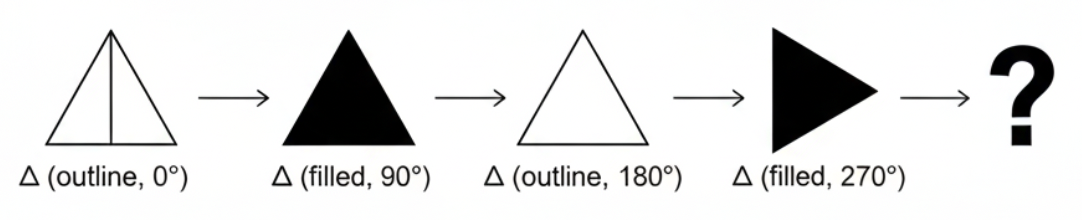
Rule: Rotation of +90° each step, fill alternates between outline and filled.
Answer: △ (outline, 0° again).