Pattern Recognition
Pattern Recognition questions in Non-Verbal Reasoning require you to observe a sequence or group of figures and identify the underlying rule that governs their arrangement. The goal is to find the missing figure, predict the next figure in the sequence, or determine which option best fits the established pattern.
These questions assess your ability to analyze visual structures, track systematic changes, and apply logical consistency.
Common Types of Patterns
| Type | Description | Example |
|---|---|---|
| Geometric Shape Patterns | Shapes change systematically in sides (triangle → square → pentagon), angles, or structure. | 3-sided → 4-sided → 5-sided → ? |
| Repetition and Alternation | Figures repeat in cycles or alternate between two or more designs. | A → B → A → B → ? |
| Rotation Patterns | Figures rotate clockwise/anticlockwise by a fixed angle. | Rotate +45° each step. |
| Reflection Patterns | Figures flip horizontally, vertically, or diagonally. | Mirror images alternate each step. |
| Number/Count Patterns | The number of dots, lines, or parts increases or decreases consistently. | 1 line → 2 lines → 3 lines → ? |
| Shading/Fill Patterns | Figures change in shading (outline → grey → black) or toggle filled/unfilled. | White → Black → White → ? |
| Position/Arrangement Patterns | Objects move in a grid or frame systematically. | Dot moves left → center → right → left → ? |
| Complex/Compound Patterns | Multiple attributes (rotation + shading + count) change together. | Triangle rotates +90° and fills alternately. |
How to Solve Pattern Recognition Questions
- Observe consecutive terms carefully: Spot what changes step by step.
- Separate attributes: Track orientation, size, shading, count, and position independently.
- Check for cycles or alternations: Look for AB/ABC or repeating sequences.
- Quantify changes: Assign numbers/angles to rotations, sides, or counts.
- Project the next figure: Apply the same rule consistently to find the answer.
Conceptual Tips and Common Mistakes
- Rotation vs reflection confusion: Always check handedness to avoid mixing up.
- Don’t assume randomness: Every given sequence follows a defined logical rule.
- Small details matter: A tiny dot, line direction, or border can define the pattern.
- Multiple changes: Be ready for compound rules where more than one attribute changes.
Examples
Example 1 — Rotation Pattern
Figures: ↑ → → → ↓ → → → ← → ?
Rule: Arrow rotates 90° clockwise each step.
Answer: ↑.
Example 2 — Alternating Pattern
Figures: □, ○, □, ○, ?
Rule: Shapes alternate between square and circle.
Answer: □.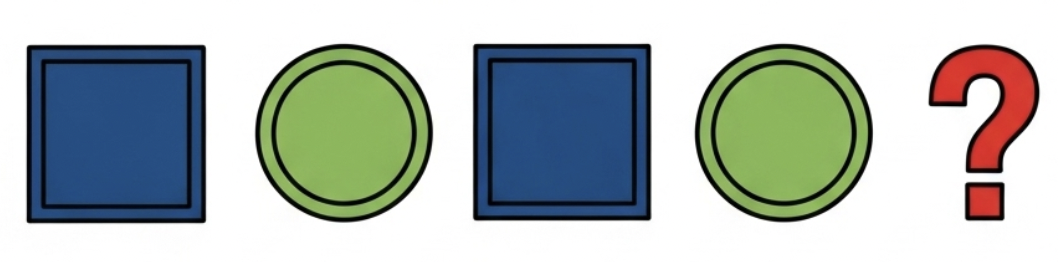
Example 3 — Count Pattern
Figures: ●, ●●, ●●●, ●●●●, ?
Rule: Add one dot each step.
Answer: ●●●●●.
Example 4 — Compound Pattern (Rotation + Fill)
Figures: △ (outline, 0°) → △ (filled, 90°) → △ (outline, 180°) → △ (filled, 270°) → ?
Rule: Rotate +90° each step; fill alternates.
Answer: △ (outline, 0° again).